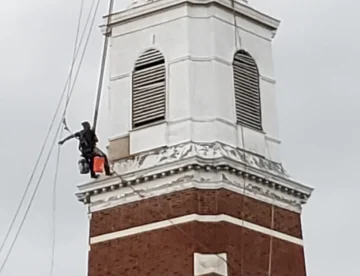
A loose cross, peeling paint near the cupola, or a dark stain spreading across a sanctuary ceiling can look like a small maintenance concern from the ground. From my experience, when working on a church building, it often can become a bigger project than expected. Our steeplejack services for churches address the places most contractors cannot safely or efficiently reach – high steeples, towers, finials, roof transitions, belfries, and ornate exterior details where water, wind, and time do their quiet damage.
For a congregation, the steeple is more than a feature on a roofline. It is a visible witness in the community and often the most exposed part of the property. Caring for it is an act of stewardship: preserving a place set apart for worship, protecting the people who gather beneath it, and honoring the generations who built it for the glory of God.
Why Church Steeples Need Specialized Attention
Steeples combine difficult access with vulnerable materials. A single structure may include aging wood framing, sheet metal, fiberglass, decorative trim, masonry, louvers, roofing membranes, sealants, and a cross or weather vane. Each material moves and weathers differently. When flashing fails at a roof-to-steeple transition or a seam opens in a fiberglass section, water can travel far from the original opening before it becomes visible indoors.
That delay is what makes elevated church repairs so consequential. By the time a leak stains plaster or damages painted sanctuary finishes, moisture may have already affected roof decking, framing, insulation, or electrical components. Small openings also invite birds, insects, and wind-driven rain into cavities that were never meant to be exposed.
A general inspection from the ground cannot reveal every problem. Binoculars, even drones, are useful for identifying obvious concerns, but they cannot test soft wood, inspect sealant failure at a joint, examine a hidden flashing lap, or determine whether decorative elements remain securely fastened. High-access inspection gives church leaders a clearer basis for planning and budgeting before an emergency dictates the work.
What Steeplejack Services for Churches Can Address
Steeplejack work is not simply painting at height. It is a specialized approach to reaching, assessing, and restoring elevated church features while limiting unnecessary disturbance to the building and its ministry. The right scope depends on the steeple’s design, age, materials, and condition.
Leak tracing and weatherproofing
Many church leaks originate at transition points: where a steeple meets the roof, around louvers, beneath decorative caps, or at flashing that has pulled away after years of thermal movement. Effective repair begins with finding the actual water path, not merely coating the area where water appears inside. This is frequently completed by systematically spraying the steeple with water while someone is inside the steeple
Repairs may include replacing failed sealants, correcting flashing, repairing damaged roofing, securing loose metal, and restoring protective coatings. A patch can be appropriate when the surrounding system is sound. When several joints are failing or the substrate beneath them is deteriorated, piecemeal patching may only postpone a larger repair. An honest assessment should distinguish between the two.
Steeple repair, rebuilding, and structural stabilization
Wooden steeples can conceal decay behind trim, metal cladding, or old paint. Fiberglass steeples may develop cracks, failed clear coats, separation at seams, or weak connections. Towers can also experience framing movement, rusted fasteners, deteriorated platforms, and damage around bell openings.
The goal is not to replace historic material without cause. Where sound material can be retained, careful repair often preserves both the building’s character and the church’s resources. Where deterioration has compromised strength or weather resistance, rebuilding affected sections may be the wiser long-term decision. A repair should leave the structure safer and more durable, not simply more presentable from the street.
Exterior restoration at difficult elevations
Steeplejack craftsmen commonly handle exterior painting, wood repair, trim restoration, metalwork, masonry repair, tuckpointing, and louver replacement in areas that are difficult to access with conventional methods. These details matter. Failed paint is not just a cosmetic problem when it exposes wood to moisture. Missing mortar in a high tower can allow water into the wall system. Damaged louvers can admit rain while preventing proper ventilation.
Historic churches require particular care. Coatings, mortar composition, window surrounds, and decorative profiles should be evaluated for compatibility before work begins. A modern material is not automatically the best choice for an older building. The repair must respect how the original assembly manages moisture and movement.
Crosses, finials, and other elevated features
A cross leaning at the top of a steeple deserves prompt attention, even if it appears secure from below. Wind loads place significant stress on mounts, fasteners, and supporting framing. The same is true of finials, lightning protection components, weather vanes, and ornamental pieces. These features should be inspected for corrosion, loose anchorage, cracks, and water entry at their base.
Why Access Method Affects Cost and Disruption
For many churches, the first assumption is that a major scaffold installation is required for any high work. Scaffolding has a proper role, especially when broad exterior areas need extensive restoration. Yet it can be expensive, slow to install, visually intrusive, and difficult to accommodate around entrances, sidewalks, landscaping, and ongoing church activity.
Specialized steeplejack methods can often reach targeted areas with less access equipment and less impact on daily ministry. Depending on the building and scope, this may reduce setup time, limit ground-level obstruction, and save the church substantial expense. It also allows focused repairs to move forward when a full-scale restoration is not yet necessary.
There are limits. A severely deteriorated steeple, broad repainting project, or reconstruction effort may require more extensive access for safety and workmanship. Wise stewardship is not choosing the least expensive method at all costs. It is selecting the approach that safely completes the necessary work, protects the building, and makes responsible use of the church’s funds.
Signs Your Church Should Schedule an Inspection
Church leaders do not need to wait for a visible failure to seek help. An inspection is especially wise after a severe storm, before launching a capital campaign, when roof work is being planned, or when deferred maintenance has accumulated over several years.
Pay close attention if you see recurring ceiling stains, peeling paint high on the exterior, loose or missing trim, cracked fiberglass, rust streaks below metal details, open joints, masonry deterioration, birds entering louvers, or a cross that appears out of alignment. Interior symptoms can also point upward. Musty odors in attic spaces, wet insulation, and water appearing around upper walls may trace back to a steeple or tower condition.
A clear inspection report helps trustees and building committees move from concern to a practical decision. It should identify immediate safety or water-intrusion issues, explain what can be monitored, and separate essential repairs from improvements that can be scheduled later. That clarity is invaluable when presenting needs to a congregation.
A Stewardship-Minded Approach to Restoration
Church restoration carries a responsibility beyond construction. Work must be planned around worship services, weddings, funerals, school schedules, and the ordinary rhythms of ministry. It should protect historic character without allowing sentiment to delay necessary repairs. It should also account for the fact that every congregation has a real budget and must make decisions prayerfully.
At Inspired Heights Ministries, that responsibility is understood as service to Christ and His Church. Multigenerational steeplejack experience, church-specific restoration knowledge, and a commitment to train skilled craftsmen all serve one purpose: helping congregations preserve the buildings entrusted to their care.
The best time to address a steeple concern is while the work is still focused and manageable. A careful evaluation and a free, no-obligation estimate can give your church a path forward – one that protects its sacred space, supports its ministry, and keeps its witness standing faithfully over the community.