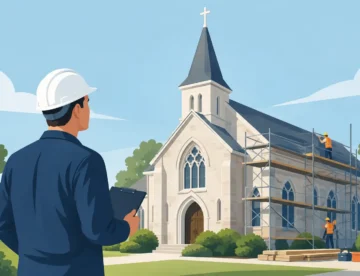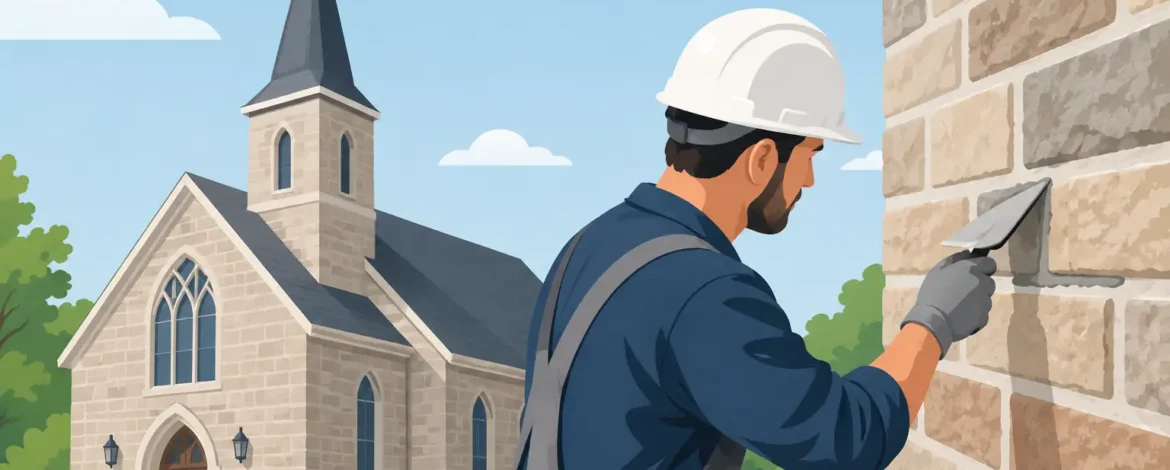
A church’s masonry often tells its story before anyone enters the sanctuary. Weathered brick, carved stone, and rising towers reflect generations of worship, sacrifice, and care. When mortar joints begin to fail, church tuckpointing repair services do more than improve appearance. They help protect the building from water, preserve its historic character, and prevent manageable repairs from becoming costly structural concerns.
For trustees and building committees, the challenge is that mortar deterioration can look minor from the ground while allowing serious moisture damage behind the wall. A careful evaluation identifies what is truly failing, why it is failing, and how to restore the masonry without compromising the craftsmanship that has carried the church through decades or even centuries.
Why Failing Mortar Requires Prompt Attention
Mortar is the joint material between brick or stone units. It is designed to weather gradually, often before the masonry itself is damaged. In a properly functioning wall, mortar acts as a sacrificial element: it absorbs movement and moisture stresses so the brick or stone can remain intact.
Over time, freeze-thaw cycles, driving rain, settling, roof runoff, and previous improper repairs can cause joints to crack, recede, soften, or separate from the masonry. Open joints give water an entry point. Once moisture gets behind the wall, it may lead to interior staining, spalling brick, rusted embedded steel, damaged plaster, rotted framing, and leaks that appear far from their actual source.
Churches are especially vulnerable because their walls are often tall, ornate, and difficult to inspect. Chimneys, parapets, bell towers, steeples, and high rooflines receive the greatest exposure to weather, yet they may be overlooked until debris falls or a leak reaches the sanctuary. A repair plan should address the source of moisture, not simply cover the visible symptom.
What Church Tuckpointing Repair Services Should Include
True tuckpointing is a precise masonry restoration process. Although the term is often used broadly to describe mortar-joint repair, quality work begins with more than applying new material over old joints. Failing mortar must be removed to an appropriate depth, usually without damaging the surrounding brick or stone. The joint is then cleaned, dampened as needed, and repointed with compatible mortar.
The word compatible matters greatly in historic church restoration. Older brick was frequently made softer and more porous than modern brick. A hard, cement-heavy mortar may seem durable, but it can trap moisture or transfer stress into the brick face. In cold climates, that can cause the brick to crack, flake, or break apart while the new mortar remains intact.
An experienced restoration contractor evaluates the existing masonry, mortar condition, wall exposure, and building age before selecting materials. Mortar color, texture, joint profile, and aggregate should also be considered. On a prominent church facade or tower, an obvious mismatch can diminish the visual integrity of the structure. The goal is not to make the repair look newly manufactured. It is to make the wall sound, weather-resistant, and faithful to its original character.
A complete scope may also include localized brick replacement, stone repair, chimney restoration, flashing corrections, sealant replacement at transitions, and repairs around windows or rooflines. Tuckpointing alone cannot solve a leak caused by failed coping stones, overflowing gutters, or damaged flashing. The best work considers the entire water-management system around the masonry.
Tuckpointing Is Not a Surface Patch
A common short-term repair is to smear mortar across cracked or recessed joints. This may hide the issue briefly, but it does not create a lasting bond and can trap moisture at the wall surface. It also leaves deteriorated material in place behind the patch.
Proper repointing takes more time because it requires controlled removal, careful packing of new mortar, and curing practices suited to the material and weather conditions. That extra care is where lasting value is found. For a congregation managing limited resources, it is often wiser to repair a defined area correctly than to spend repeatedly on cosmetic patching.
Signs Your Church May Need Masonry Repairs
Some warning signs are visible during a routine walk around the building. Look closely at lower walls, chimneys, buttresses, parapets, and areas beneath gutters or roof valleys. Mortar that is missing, deeply recessed, cracked, powdery, or washed out deserves attention.
Other signs point to a more advanced problem. These include loose or spalling brick, white mineral deposits known as efflorescence, interior dampness, peeling paint near exterior walls, cracking around window openings, or pieces of mortar on sidewalks below elevated masonry. If a wall bows or individual bricks move when touched, restrict access to the area and request a professional assessment promptly.
Not every crack calls for the same repair. Fine, stable cracks may be primarily cosmetic, while stair-step cracking can indicate differential settlement or movement. A church with a century-old masonry tower needs a different approach than a newer brick veneer building. A responsible contractor will explain that distinction rather than prescribe the same solution for every wall.
High-Access Work Changes the Repair Strategy
Many church masonry problems occur where conventional contractors have difficulty working: above a steep sanctuary roof, around a bell tower, near a steeple base, or along a narrow courtyard elevation. Extensive scaffolding can sometimes be necessary, but it is not always the only option.
Specialized steeplejack and rope-access methods can allow trained craftsmen to inspect and repair difficult areas with less intrusive access. This can reduce the footprint around the church, avoid prolonged disruption to entrances and ministries, and in some cases lower project costs. The right method depends on the wall condition, height, local safety requirements, material handling needs, and scope of repairs.
High-elevation work should never be treated as a simple add-on. Workers need the training, equipment, and church-restoration experience to protect the building, the congregation, and the public below. This is particularly true when loose masonry, lead-based coatings, aging decorative features, or deteriorated roof edges are involved.
Planning Repairs With Stewardship in Mind
A clear assessment helps church leaders make decisions without guessing. Before approving a large masonry project, ask for a scope that identifies the affected elevations, the likely cause of deterioration, the proposed mortar and repair method, access approach, and related issues that should be handled at the same time.
Phasing can be a sensible option when damage is widespread but the budget must be managed carefully. Safety-critical areas and active leaks should come first. Next, address elevations receiving the heaviest weather exposure and areas where mortar loss is putting brick or stone at risk. A multi-year plan can help a church budget responsibly while preventing deferred maintenance from growing unchecked.
There are trade-offs. A limited repair may be appropriate when deterioration is isolated and the rest of the wall remains sound. Broad repointing may be more economical over time when joints are failing across an entire elevation. Likewise, a waterproof coating is not automatically the answer. Some masonry walls need to breathe, and an inappropriate coating can hold moisture inside rather than solve the underlying problem.
Good stewardship is neither postponing every repair nor replacing historic material unnecessarily. It is understanding the condition of the building and choosing work that preserves what God has entrusted to the congregation.
Preserving a Place Set Apart for Worship
Church masonry is not merely a building envelope. It shelters prayer, teaching, fellowship, weddings, funerals, and the ordinary faithfulness of a congregation. Restoring it with care honors both the craftsmanship of those who built it and the ministry that continues within it.
Inspired Heights Ministries approaches this work as service to Christ, combining church-specific restoration knowledge with the practical skill required for difficult masonry and high-access conditions. The aim is not a quick visual fix, but durable work that helps preserve His Church for the people who gather there now and those who will gather there after us.
If mortar joints are beginning to fail, do not wait for a sanctuary leak or falling brick to force the decision. Schedule a careful exterior review, document what is found, and give your church leaders the information needed to act faithfully and wisely.